






Ecomm Wizards
Shopify app development Raleigh

Shopify app development company Raleigh brands hire when the app they need doesn't exist

Custom apps that run on your own store, and public apps built for the App Store. Tell us what the app has to do and we will tell you which one you need.

150+
Stores built
$400M+
Revenue generated
8+
Years building stores
4.9★
Average client rating
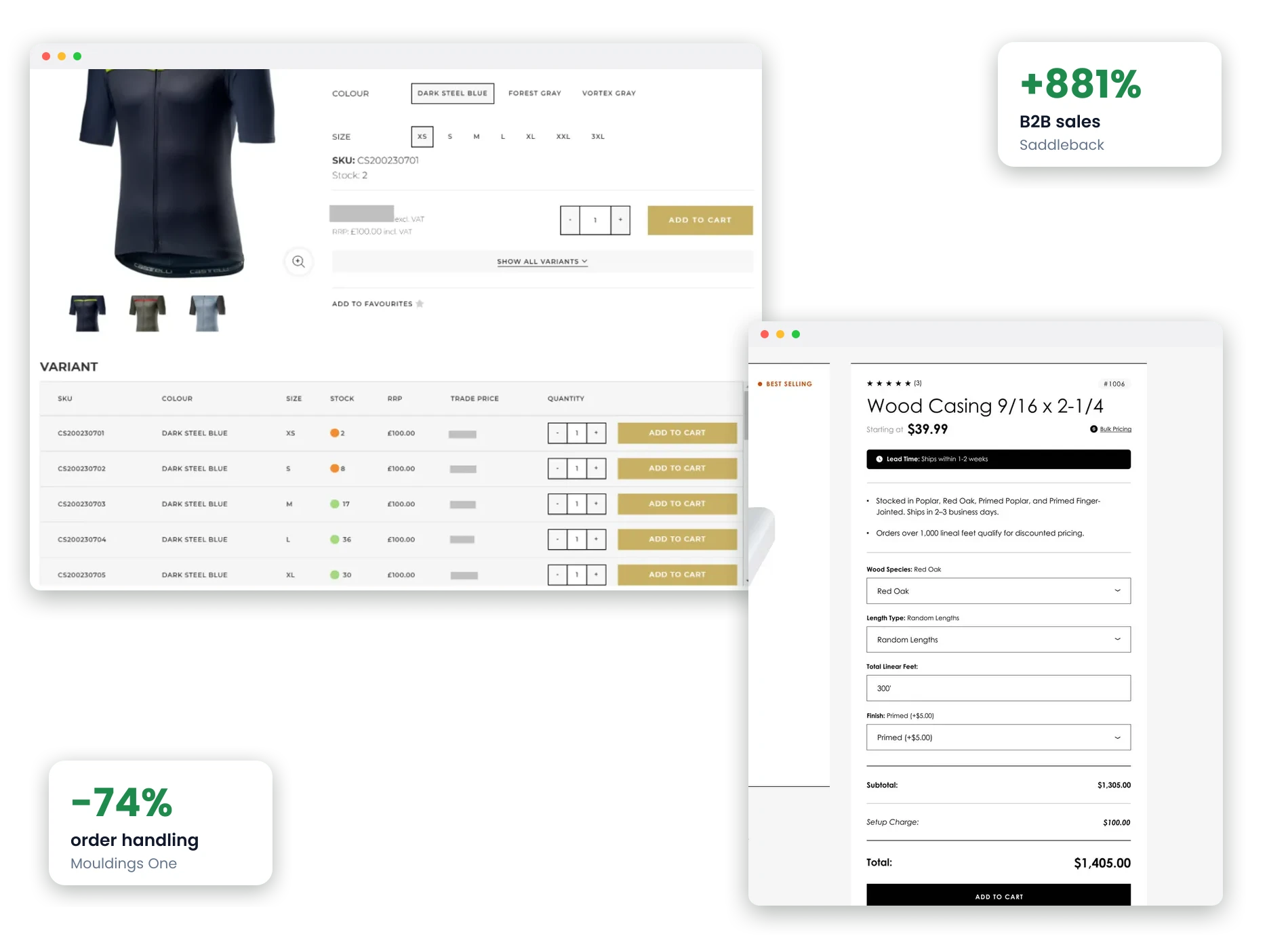
A trade ordering screen we built for Saddleback showing stock and bulk quantities per variant, and a made-to-order configurator we built for Mouldings One, with results of 881% more B2B sales and 74% less order handling

150+ stores built, and the custom work behind them.

Trade portals, credit tools, ERP syncs and point of sale. Built for one store or for the App Store.

Two very different jobs go by the same word. One runs on your store and nobody else's. The other has to survive the App Store.

So we counted. We read 264 apps across seven App Store categories. In the middle category, five apps hold about half the reviews. In two, nearer seven in ten.

Which one you need changes the build, the timeline and what you own at the end. Most settle that too late. It is the first question any Shopify app development company Raleigh brands hire should put to you.

In short

Ecomm Wizards is a Shopify app development company Raleigh brands hire for two things. We build custom apps that run on your own store. We also build public apps for the Shopify App Store, and handle the review and the listing.

The point where the app stops fitting

Nobody plans the systems they end up with. What works at fifty orders a day holds. At five hundred it stops: a workaround here, a manual export there, a spreadsheet nobody admits to.

By then you have usually stopped looking for an app. The one you need does not exist, or it exists and does nine tenths of the job.

It is rarely the whole system that breaks. It is one step: the way your sizes map to a supplier, or the rule that decides which warehouse ships, or the discount one account was promised years ago. A Shopify app development company Raleigh brands hire should scope that step, not the rebuild around it.

Custom builds we shipped, and what they changed

Saddleback ecommerce store, a custom credit app showing live balances at checkout, plus CSV bulk ordering

Saddleback

  • Shopify Plus B2B
  • Custom Development
  • UX Design
Vertical
Cycling distribution
What was built
A custom credit app showing live balances at checkout, plus CSV bulk ordering
Outcome
+881% B2B sales in month one, 9.54% conversion rate
Mouldings One ecommerce store, custom trade logic and a live ERP sync behind a self-service portal

Mouldings One

  • Shopify Plus B2B
  • Custom Development
  • ERP Integration
Vertical
Architectural supply
What was built
Custom trade logic and a live ERP sync behind a self-service portal
Outcome
+50% B2B revenue, order processing time down 74%
NEOM Wellbeing ecommerce store, shopify POS joined to the online store across four retail hubs

NEOM Wellbeing

  • Shopify 2.0 Upgrade
  • POS Integration
  • Shopify Markets
Vertical
Wellbeing
What was built
Shopify POS joined to the online store across four retail hubs
Outcome
+34% checkout conversion, +10% order volume

Shopify has two kinds of app, and they are not the same project

A custom app is installed on one store. Shopify calls this custom distribution: your store only, or stores belonging to one Plus organization. It never goes near a listing, a review queue or a stranger's shop. It does exactly what you asked for and nothing else.

A public app can be installed by anyone, and has to earn that. Public distribution means any store can install it, which is why it goes through Shopify's app review before it is listed. There is a requirements checklist to clear first, covering prohibited behavior, performance, security and what the listing itself must show.

The build is different, the timeline is different, and the thing you own at the end is different. Most of the work in a public app is not the app itself. Anyone on your Shopify app development company Raleigh shortlist should plan those two jobs apart.

What seven App Store categories look like from the inside

This is the homework a Shopify app development company Raleigh brands hire should do before it takes your brief. We read every app card on the seven top-level category pages in September 2026, 264 apps, and counted how much of each category's reviews the five biggest hold.

What seven App Store categories look like from the inside
CategoryApps shownShare of reviews held by the top five
Finding products3170%
Store designThemes, page builders and the tools most stores reach for first.3369%
Sales channels3667%
Selling products3653%
Store management4150%
Orders and shipping4340%
Marketing and conversionThe most crowded category we counted, and still the top five hold nearly four reviews in ten.4439%

That cuts two ways, and which way depends on why you came. If you want an app to install, you have fewer real options than the page suggests. The gap between what those five do and what you need is where custom work starts. If you want to publish one, you are launching into a category where five apps already hold half the credibility.

Neither of those is a reason not to build. Both change what you should be building, and that is the conversation to have with any Shopify app development company Raleigh shortlist before the scope is set.

Three things to settle before anyone writes code

  • Who installs this. Just your store, or anybody who finds it in the App Store. That one answer changes the build.
  • What happens if the app stops. If the answer is that orders stop, it needs a different standard of care.
  • Whether the job is one feature or a product. A feature can be custom and quiet. A product needs a listing, a review and support.

Why the two builds stop looking alike

A custom app answers to one store. It can assume your catalog, your workflow and your edge cases, because there is exactly one of each.

A public app cannot assume anything. It has to work on a store it has never seen, survive review, and keep working when Shopify changes underneath it.

That is why the two timelines look so different. The feature is often the small part of a public app. A Shopify app development company Raleigh brands keep will scope the rest of it before you commit.

Not sure which of the two you need? Tell us what the app has to do and we'll say.

Get in touch with us

How an app build actually runs

Six steps, the same for a custom app and a public one. A public app takes its extra time on the last two. It is the sequence any Shopify app development company Raleigh brands hire should be able to show you up front.

  1. Week one

    We settle which app this is

    Custom or public, decided on the first call and written down. Most scopes end up smaller than the one people arrive with.

  2. Week one to two

    We map what it has to touch

    Your products, your orders, your warehouse, your accounting. Most of an app is the joins between them, and we list all of them first.

  3. Weeks two to four

    We build it with Shopify's own tools

    It reads your store through Shopify's data connection, not a copy. It sits inside the admin your staff already use, and looks like it belongs there.

  4. Weeks three to five

    You click it on a copy of your store

    We build on a development store, never on the shop taking money. You use the working app and tell us what is wrong while it is still easy to change.

  5. Before launch

    We try to break it

    A bad address, a sold-out item, two people saving the same order. The failures that matter are the ones nobody planned for.

  6. Launch

    It installs, or it goes to review

    A custom app installs on your store and that is the end of it. A public one goes to Shopify's review queue first, and we take that pass with you.

What you get either way

Four things that hold on a one-store app and an App Store launch. Any Shopify app development company Raleigh brands bring in should commit to all four.

  1. We will talk you out of it

    If the job is a feature on your own store, we say so, even when the bigger build was ours to sell.

  2. The code is yours

    Your app, your Partner account, your listing if there is one. Nothing sits with us that you would have to ask for back.

  3. It keeps working after we leave

    Shopify changes its platform on a schedule. You get a handover of what runs, what it depends on, and what will need attention.

  4. Scope is agreed before work starts

    If it has to change, you see it and agree before anyone acts on it.

What usually gives people pause

“Isn't there already an app for this?”

Often there is, and if it fits we will tell you so. The table above is the check: a category is mostly five apps, and those five solve the common case.

Custom work starts where your case stops being common. Any Shopify app development company Raleigh brands trust should run that check before agreeing to build you anything.

“We don't want something only one developer understands.”

Nor do we. Anything only one person can read is a risk to us too.

So the documentation arrives during the build, not at the end. Put it in front of a developer you trust while there is still time to fix what is unclear.

“We tried building one before and it stalled.”

Usually the scope was a product when everyone thought it was a feature. Or the App Store rules arrived late.

Both are planning failures rather than coding ones. A public build carries the review pass in the plan from the start, not as a late surprise.

What it takes from your side

Less than most people expect. It is usually an hour or two a week from whoever knows the workflow best, because that person is the only one who knows the edge cases.

You do not need a developer of your own. Nobody on your team has to learn anything new.

What we do need is one person who can say yes. A build that waits a week for every decision runs long, and no Shopify app development company Raleigh brands hire can fix that from the outside.

The first conversation is about which of the two you need. It costs you nothing, including when the answer is neither.

Get in touch with us

What brands ask before they build one

  • Who can install it. A custom app goes on your store only, or on stores in a single Plus organization. A public app can be installed by anyone, which is why it goes through Shopify's review before it is listed.

  • Private is the older name for a custom app, so if only your store will use it, that is the one you need. A public app is right when the thing you built is a product other merchants would install.

  • A checklist you clear before your app is listed. It covers what apps may not do, how fast the app runs, how it handles data, and what your listing has to show. Checkout and post-purchase apps have extra rules. Shopify reviews the submission.

  • A custom app with a tight scope is usually weeks, not months. A public app takes longer, and the extra time goes on the listing and the review pass, not the feature. Any Shopify app development company Raleigh shortlist should give you both timelines up front.

  • Yes, and that is usually the reason to build one. A theme changes what the store looks like and how it behaves for a visitor. An app can hold logic, talk to your other systems and keep running when nobody is looking at it.

  • Yes, and remotely is how it runs. There is no office in the city to visit. Where your office sits does not change how the work is scoped, built or handed over.

  • You do. The code, the Partner account and the App Store listing sit in your name from day one, not ours. Nothing has to be handed back, because we never held it. Ask that of every Shopify app development company Raleigh brands recommend.

  • Usually. We read what is there first. Then we tell you whether it is worth continuing or starting again. A build nobody wrote down can take longer to inherit than to replace.

  • Shopify keeps changing, so something will eventually need attention. Most brands keep us on for that. If you would rather hand it to your own developer, the documentation goes with it.

  • Shopify's own tools, mostly. The app reads your store through Shopify's connection rather than a copy of your data, and it sits inside the admin your staff already use. There is no second system for anyone to log into.

  • It can, which is worth asking before you build one. Shopify's rules for listed apps cover how fast the app runs, and we hold a custom app to the same standard. Anything that does not have to happen while a shopper waits gets moved out of their way.

  • Usually, as long as your existing software will let it. Accounting, warehouse, stock and point of sale mostly have a way in. We map yours in the first two weeks, because an app that cannot reach your other systems is the most common reason a build stalls.

  • No. A custom app can be installed on a single store on any plan. Plus only matters when you want one app installed across several stores that belong to the same organization.

Next step

Tell us what the app has to do

The same three questions, answered for your own store.

Tell us what the app has to do and we will come back with:

  1. Which of the two builds it is, and why.
  2. What it would have to talk to on your store.
  3. What you would be signing up to keep running afterwards.

It stops at the answer, and you can take it to any developer.

No charge, and no follow-up sequence.

A developer replies within one working day. Not a salesperson.

We've scaled 150+ stores. Let's see what's holding yours back.

Book a Free Call