
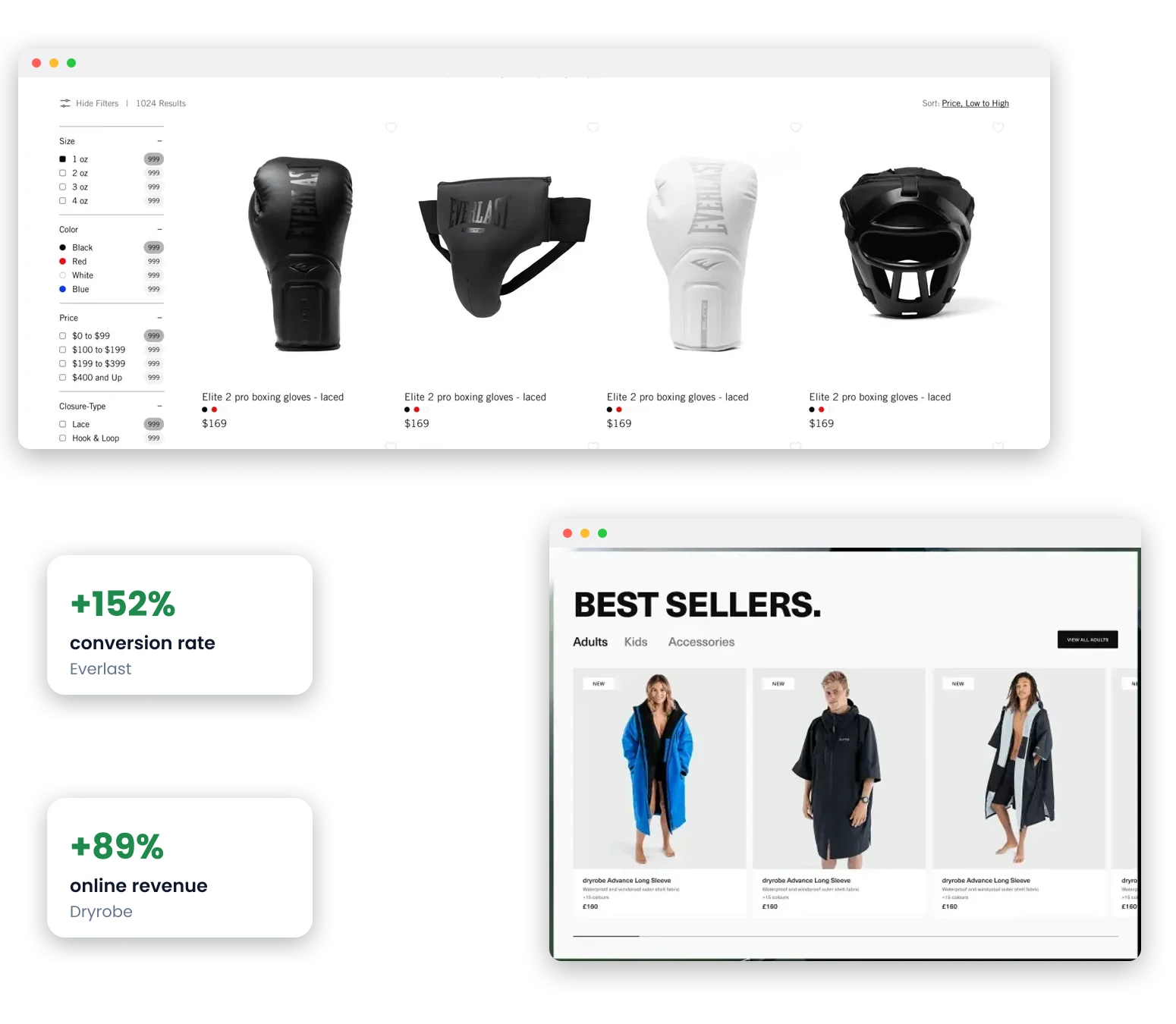
Design and build
We build the store around how people actually shop it
- Storefront build
- Theme development
- Product data
- Checkout
- Design systems

Only ever Shopify, never WordPress or Magento. That is what a Shopify agency Minneapolis brands keep should mean.







Minnesota does not charge sales tax on clothing. Most people here know that. Far fewer know where the state stops calling something clothing.
A hat is exempt. A helmet is not. A belt sold with the trousers is exempt. The same belt sold on its own is not. Sunglasses, watches, handbags and cleated shoes are all taxable, and they sit in the same catalog as the shirts.
So we counted. Across 26 apparel and outdoor catalogs, 21 sold both kinds at once. The middle store had 2% of its products on the wrong side of a store-wide setting. It is the first thing a Shopify agency Minneapolis brands hire should check on yours.
In short
Ecomm Wizards is a Shopify agency Minneapolis brands hire to design, build, move and grow stores. We work on Shopify and nothing else. We get your settings right, including the tax ones most stores never check.
Minnesota is one of a handful of states that does not tax clothing, and it is the kind of fact everyone repeats and nobody finishes. The exceptions are where the money is.
The state draws the line at general use. Something you wear every day is clothing. Something you wear to play a sport, to protect yourself at work, or to carry your things is not.
That line runs straight through an ordinary apparel catalog. It is why a Shopify agency Minneapolis brands hire often gets called after the accountant has asked a question.

Everlast
Dryrobe

Capelli Sports
Accessories are taxable. Handbags, wallets, belts sold on their own, jewelry, sunglasses, watches and umbrellas. The state's test is whether the item is worn on the person or alongside clothing rather than being clothing itself.
Sports and protective gear are taxable. Anything worn for an activity that is not suitable for general use: cleated shoes, ski boots, helmets, life vests. Work protection counts too, including hard hats, safety glasses and welding gloves.
Fur is taxable where the fur is worth more than three times the next most valuable part of the garment.
None of that is set at the store level. It is a decision per product. Shopify does exactly what your product settings tell it to, which is why a Shopify agency Minneapolis brands hire should check them in week one.
Nobody ranking for this work mentions tax at all, so here is the rule and our own count against it. We read 26 apparel and outdoor catalogs and sorted every product against the state's published examples. Any Shopify agency Minneapolis brands trust should be able to do the same for one store.
| Item | Taxed by Minnesota | In the 26 catalogs |
|---|---|---|
| Shirts, trousers, coats, shoes, hats | No | Every store |
| Handbags, wallets, backpacks480 of the 516 taxable items we found were accessories. | Yes | The largest group by far |
| A belt sold on its ownThe same belt sold with the trousers is exempt. A product list cannot tell you which it is. | Yes | Common |
| Sunglasses, watches, jewelry | Yes | Common |
| Cleated shoes, ski boots, helmets | Yes | 17 items |
| Hard hats, safety glasses, welding gloves | Yes | 17 items |
| Fur, where the fur is most of the value | Yes | 2 items |
| Stores selling both kinds at onceThe middle store had 2% of its catalog on the taxable side. The highest had 32%. | 21 of 26 |
Two percent is the number worth sitting with. It is small enough that nobody notices it, and it is wrong on every Minnesota order the store takes.
It is also not the exotic stuff. Ski boots and welding gloves barely showed up. 93% of what we found was the accessories tab: bags, belts, sunglasses, watches. They sit in the same catalog as the shirts and inherit whatever the shirts were set to.
Five of the 26 sold nothing taxable at all, and for them one setting is fine. Knowing which of the two you are is the point. Ask any Shopify agency Minneapolis brands shortlist to tell you.
Shopify will do what the product says. Tax behavior is carried on the product, so the answer has to be right at the point each one is created, not corrected later in a spreadsheet.
Which makes it a process question. Somebody adds forty products before a season. If the right setting is not part of how they get added, the catalog drifts back within a month.
And it is checkable. A Shopify agency Minneapolis brands keep should show you the state of it in an afternoon. Then say whether it needs fixing once or fixing properly.
Want the same count run on your own catalog? Tell us the store and we will send what we find.
Get in touch with usWhat we do
Take one or take all four. Every row links to the store it was done for, and all of it is Shopify. That is the range a Shopify agency Minneapolis brands hire should cover.
Design and build
Configuration
Migration
Growth
Not sure which of the four you need? Describe the store and we will say where we would start.
Get in touch with usFour things that hold whatever you buy. Hold every Shopify agency Minneapolis brands talk to against the same four.
No WordPress, no Magento, no hedging. It is the reason we know where the settings hide.
You get told what is actually wrong first, and sometimes the answer is less than you expected.
The code, the accounts and the app subscriptions are in your name. If you leave there is nothing to ask us for.
If it has to change, you see it and agree first.
They should, and we are not trying to take that off them. The split is simple enough.
They decide what the treatment should be. We make your store actually do it, on the right products, in a way that survives the next person adding forty more.
It calculates rates automatically, which is not the same as knowing what your product is.
It applies whatever category and tax setting each product carries. Get the product wrong and the maths is perfect on the wrong answer.
Often it is not, and we will say so. Five of the 26 stores we read needed nothing at all.
But it is worth an afternoon to find out which of those two you are, because the version where it does matter has been wrong on every order since launch.
Fair, and unlike most markets there are good people here to choose from. Someone in the room for a workshop is worth having.
Just ask both of us the same thing first. Ask what a store-level tax setting does to your accessories collection. Any Shopify agency Minneapolis brands shortlist should answer that without looking it up.
With a list of every product carrying a tax setting that disagrees with the rest of its collection. That single list usually explains the problem, and it takes an afternoon.
Then the question is whether it needs fixing once or fixing properly. Once is cheaper and it comes back. Properly means the right setting is part of how a product gets created, so next season does not undo it.
You get both answers and the difference between them. Any Shopify agency Minneapolis brands hire should be willing to start with the smaller one.
The first conversation is about what is actually wrong. It costs you nothing, including when the answer is that we would change very little.
Get in touch with usGenerally no. The state exempts clothing meant for general use: shirts, trousers, coats, shoes, hats. What it does tax is the accessories, sports gear, protective gear and fur sitting beside them in your catalog.
Yes. Handbags, wallets, belts sold alone, jewelry, sunglasses, watches and umbrellas are all taxed. The clothing beside them is not. This is where nearly all of it lives, and probably where most of yours does: 480 of the 516 taxable items we found were accessories.
It works out rates automatically. It does not decide what your product is. Shopify uses the tax setting each product carries, so a correct sum on the wrong product is still the wrong amount.
A rule that tells Shopify to treat one collection or product differently from the default. It is the usual way to handle a mixed catalog. It is only as good as the collection you point it at.
Register where you need to, turn on tax collection for those regions, then decide product by product what is taxable. The first two take an afternoon. The third is the part that gets skipped.
Four things, usually. Design how your store looks and how people move through it. Build what a theme will not cover. Move you onto Shopify when you have outgrown something else. And keep testing what makes people buy.
No, and that is deliberate. Ask everyone else on your list how many platforms they sell. We only do Shopify, which is why we know where your settings hide.
Yes, and remotely is how it runs. There is no office in the city to visit. Where you sit does not change how the work is scoped, built or handed over.
Usually, and often it is the quickest route. We can scope and hand over, or take the parts nobody on your team has time for. We will not quietly replace somebody doing a decent job.
Finding it is an afternoon, and any Shopify agency Minneapolis brands hire should do that part before proposing anything. Fixing it once is days. Fixing it so it stays fixed means changing how your products get created, which is a week or two.
Next step
The same count we ran on 26 catalogs, run on yours.
Send the store address and we will come back with:
It stops at the findings, and you can hand them to your accountant or anyone else.
No charge, and no follow-up sequence.
A developer replies within one working day. Not a salesperson.
