
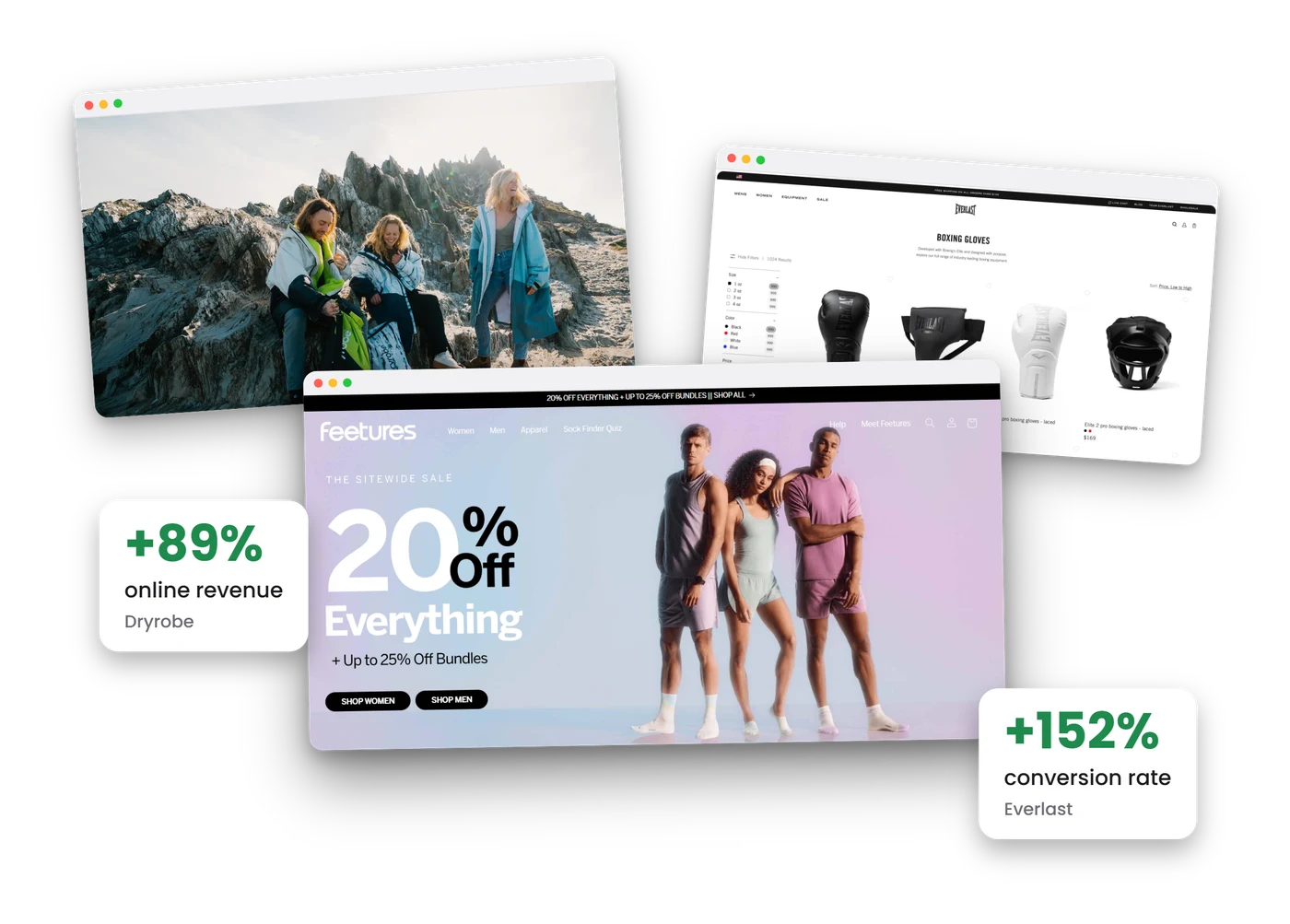
Custom theme
We design a theme around your catalog, then build it in Liquid
- Theme design
- Liquid development
- Online Store 2.0 sections
- Metafields
- Product pages

Sportswear, skincare, confectionery, jewelry. Different catalogs, all designed to be shopped on a phone.








A design is signed off on a big screen, in a quiet room, with the images already loaded.
Your customer meets it on a phone, on a patchy signal, behind whatever scripts your apps put in front of it. So we ran Google's own speed test on 26 California stores you'd recognize. The middle one scored 28 out of 100.
Every number is below, with what we would change first.
In short
Ecomm Wizards is a Shopify web design agency California brands use for custom themes, redesigns and Shopify Plus builds. We design mobile first, then build your theme ourselves. Speed work is part of the design, not a job for afterwards.
Nineteen of the twenty stores in our scan that show a Shopify theme run a custom one. No surprise there.
Seven of those started from a stock theme. Four are built on Dawn, the free theme Shopify ships with every new store and calls its reference for performance. Custom and stock aren't two different worlds. Most good custom work starts from one and rebuilds the parts that earn it.
Six run no Shopify theme at all. Their storefront has moved off the theme layer, which is a far bigger project than a redesign and rarely the one you need.
So the real question isn't custom or stock. It's which parts of your store deserve custom work, and what that work costs you in weight. That's the question to put to anyone you're considering.
Feetures

Dryrobe

Everlast
What we design
A Shopify web design agency California brands hire should let you buy the one you need. Each row links to the store it was built for.
Custom theme
Redesign
Speed and weight
Test and improve

Google's bar is 2.5 seconds for your main image to appear, measured on real visits. In our lab test, 25 of the 26 missed it.
Shopify isn't the reason. Field data from 2025 has Shopify passing all three of Google's checks on 76% of sites, ahead of every other big platform.
What gets added on top is. The middle store in our scan shipped 3.4 MB of JavaScript and pulled scripts from 27 outside companies. Every one of those arrived as a decision, not a fault.
And the money follows the milliseconds. A study of 37 retail brands found that taking 0.1 seconds off a mobile site lifted conversion by 8.4%.
We opened each homepage on a phone-sized screen, counted what it downloaded, then ran Google's Lighthouse test on it. Brands are counted, not named.
| The check | What we found on 26 stores | What it means for your design |
|---|---|---|
| How fast does your main image appear?Usually a hero video, a giant image, or a script that has to run before the picture is allowed to load. | Median 9.6 seconds, and 12 stores took over 10 | Google's bar is 2.5 seconds |
| What does your homepage weigh?Hero media is the biggest single piece, and it's the easiest one to fix without touching the design. | Median 7.8 MB, heaviest 33 MB | A phone on a weak signal pays for every megabyte |
| How much code does it load?Phones don't just download it, they have to run it. That's what the delay before the page responds is made of. | Median 3.4 MB, and 16 stores over 3 MB | This is where your apps land |
| How many outside companies load code?Reviews, chat, quizzes, pixels, popups. Worth listing yours and asking which still earns its place. | Median 27 per store, most 48 | Each one was somebody's decision |
| Does the page jump while it loads?Almost always an image or banner with no space reserved for it in the layout. | 5 of 26 moved more than Google allows | Shoppers tap the wrong thing |
| What runs underneath the design?Four of those seven build on Dawn, the free theme Shopify calls its reference for performance. | 19 of 20 custom, but 7 built on a stock theme | Custom or stock is the wrong question |
Read the middle column. Only 2 of the 26 scored 50 or better out of 100, and these are brands with real design budgets.
That's the useful part. Your store isn't behind because the design is bad. It's behind because weight arrives quietly, one app and one hero video at a time. Run the same test before anyone on your Shopify web design agency California shortlist shows you a moodboard.
Hero media. An autoplaying video is the single heaviest thing on most homepages, and 6 of the 26 run one above the fold.
Apps you no longer use. The scripts stay after the trial ends, and they load on every page for every shopper.
Fonts and icon sets. Easy to add during design, rarely subset afterwards.
Images at desktop size. A phone downloads the full picture and then shrinks it on screen.
Your hero. Poster image first, video after it loads, or no video at all on a phone.
Your app list. Remove what's unused, replace what your theme can do natively, keep what earns its keep.
Reserved space. Give every image and banner its size in the layout so nothing jumps.
Then the design work. Once your store is light, a new look doesn't have to fight the page for the first three seconds.
Four things that hold for a single template or a full theme.
Layouts are reviewed at phone size before desktop, because that's where most of your shoppers are.
Sections and blocks are built so your marketers can change a page without opening the code or calling a developer.
Your repository, your theme and your app accounts. Nothing sits with us that you'd have to ask for back.
If it needs to change, you see the change and agree to it before anyone carries on.
Then keep them. Plenty of brands send us finished designs and we build the theme.
What we'd ask for is a look at your design on a phone before it's signed off, so the weight is your choice rather than a surprise.
Agreed, and that's rarely all-or-nothing. Four of the stores in our scan run on Dawn and still look nothing like each other.
The parts worth building from scratch are the ones your customers use to choose: the product page, the finder, the cart.
Fair, and that's a real risk when URLs and page structure change. We keep the structure, the redirects and the headings in the plan from the first week, not the last.
Any Shopify web design agency California brands trust should show you that plan before the design.
Different brands from the ones above. Each number links to its case study, so you can check it.
Working with Ecomm Wizards gave us a clear roadmap for growth. The skin finder quiz alone transformed how our customers discover the right products, and the results across conversion rate and revenue speak for themselves.

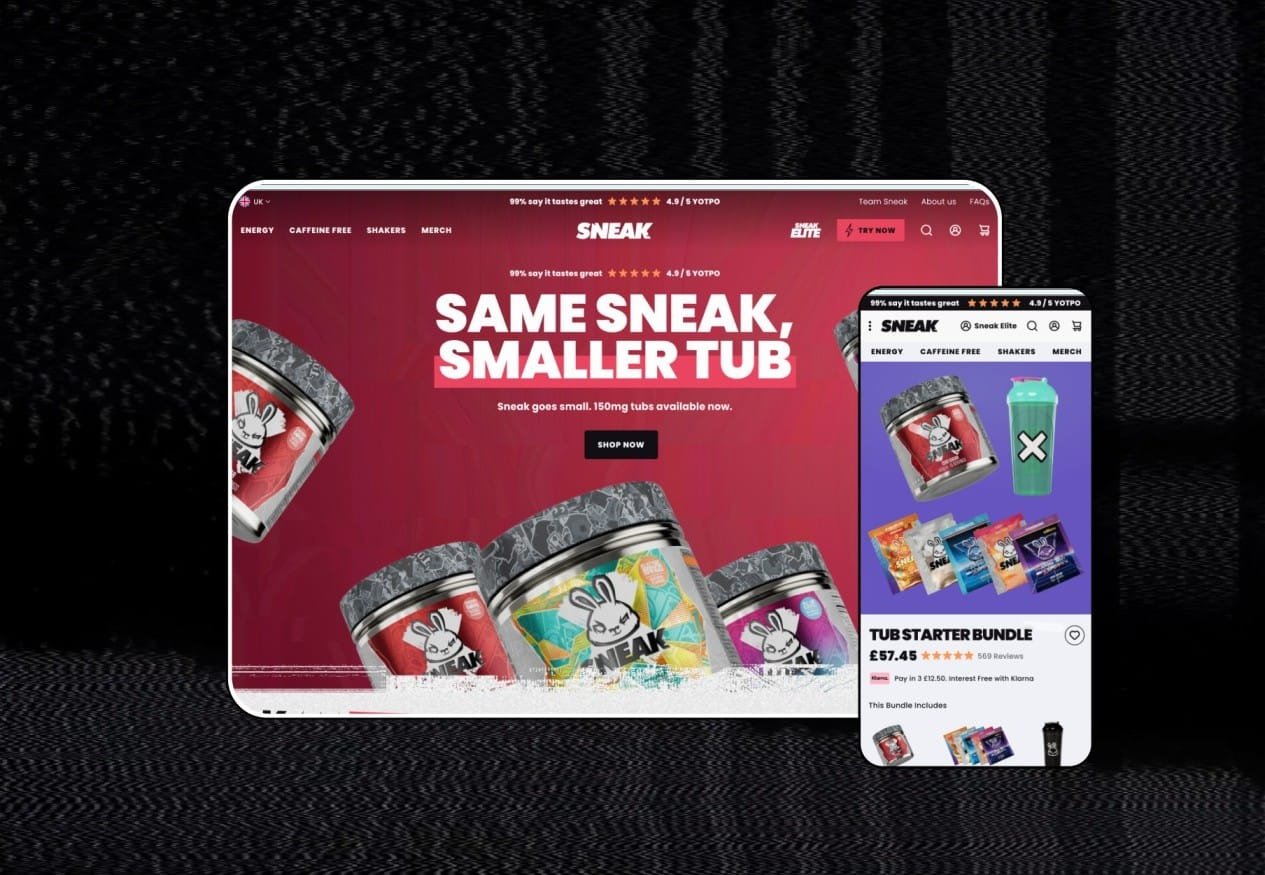
We are grateful to the team at Ecomm Wizards, who translated our vision into an outstanding design. Mobile performance in the first weeks post-launch spoke for itself.

The migration was seamless. Our customers noticed nothing, and neither did Google. The new store architecture reflects how our buyers actually shop, and the conversion numbers followed. Ecomm Wizards delivered exactly what they promised.

It starts with the same tests, run on your homepage and your top product page. You get the numbers, the weight, and the list of what's making it heavy.
Then we design. Phone layouts first, then desktop, then the sections your team will use to build pages later. You see the design on a real device before anyone writes Liquid.
Whoever you hire, ask to see that list before a moodboard. Make it the first question in every Shopify web design agency California pitch you sit through.
Most stores launch in 6 to 10 weeks, and a simple direct-to-consumer build takes around 6. A single template on your store, like a product page, is quicker than that.
Both are normal. In our scan, 7 of the 20 stores on a Shopify theme were built on a stock one, four of those on Dawn. Start from stock where it already does the job, and build custom where your customers choose.
Because most of the weight isn't Shopify's. The Web Almanac has Shopify passing all three of Google's speed checks on 76% of sites. In our scan the middle store shipped 3.4 MB of JavaScript and pulled scripts from 27 outside companies, and that's what your shoppers wait for.
Not if your URLs, redirects and page structure are planned with the design. That's the part that goes wrong when design and development are split across two suppliers.
Usually one template rather than the whole store. A product page or a collection page, designed, built and measured, then the rest once you've seen the result.
Yes, and we're remote, with no office in the state. Theme work is our day job: Liquid, Online Store 2.0 sections and the speed work that follows. Your project runs the same way wherever you are.
Design for phone and desktop, the theme build in Liquid, and the speed work that keeps it quick. You see the scope in writing before anything starts.
Nobody can promise you a number, and it's worth being wary of anyone who does. What we can show you is what happened on three stores: add to cart up 32%, online revenue up 89%, conversion rate up 152%. Yours starts with the measurements, so you see the change rather than take our word for it.
Yes, and that's most of what we do. We redesign templates inside the theme you already run, which keeps your settings, your content and your team's habits.
Next step
The same two tests from the table, run on your store.
Put your homepage in the form. We'll test it and hand you the findings:
It stops at the findings, and you can take them to any developer.
No charge, and the report is yours either way.
You'll hear back from a developer within a working day.
