
Design and build
We build themes where the facts that sell load with the page
- Theme development
- Custom development
- Product data and metafields
- Structured data
- Shopify POS

Sportswear, food and drink, wholesale, jewelry. Brands selling direct, through retailers, or both.







Every Shopify agency Boston brands consider promises fast, beautiful, high-converting stores. Ours included. None of it can be checked from outside.
So we measured something you can check. We opened 26 New England brand stores and read their product pages the way a search engine does, clicking nothing. On half, there was no product description to find.
It is all below, with the six checks, so you can run them yourself.
In short
Ecomm Wizards is a Shopify agency Boston brands use to design, build, migrate and grow a store, direct to consumer and B2B. We work on Shopify and Shopify Plus. Before a build goes live, we check what your product pages give a search engine, not only what they show a shopper.
Six kinds of store, and what each needs from a build. Find yours, then ask how a Shopify agency Boston brands trust would build it.
Fit decides your sale and your return. Sizes, measurements and fit notes belong in product data that loads with the page.
What breaks first: A size guide that opens only on a click. Search never sees it, nor does a shopper in a hurry.
Your ingredients, allergens and weights belong in plain text. Nobody with an allergy opens three tabs to find them.
What breaks first: An allergen line that lives only inside a photo of the pack.
Dose, serving size and what is in the bottle decide your sale. They belong in product fields, not in a theme.
What breaks first: A facts panel saved as a flat image, with nothing in text behind it.
Your trade buyers get their own prices, order minimums and terms. All on the store your shoppers already use.
What breaks first: Trade prices shown to retail shoppers, because one theme runs both with no company accounts behind it.
Size, material and care are the questions your inbox keeps answering. Store them once and they show up everywhere.
What breaks first: Dimensions written into a photo, and returns that come back as bigger than expected.
Your shades, sizes and sets sit on one product page, and each option carries a name, not just a colored circle.
What breaks first: Shade names a shopper cannot read on a phone, so the wrong one arrives and goes back.
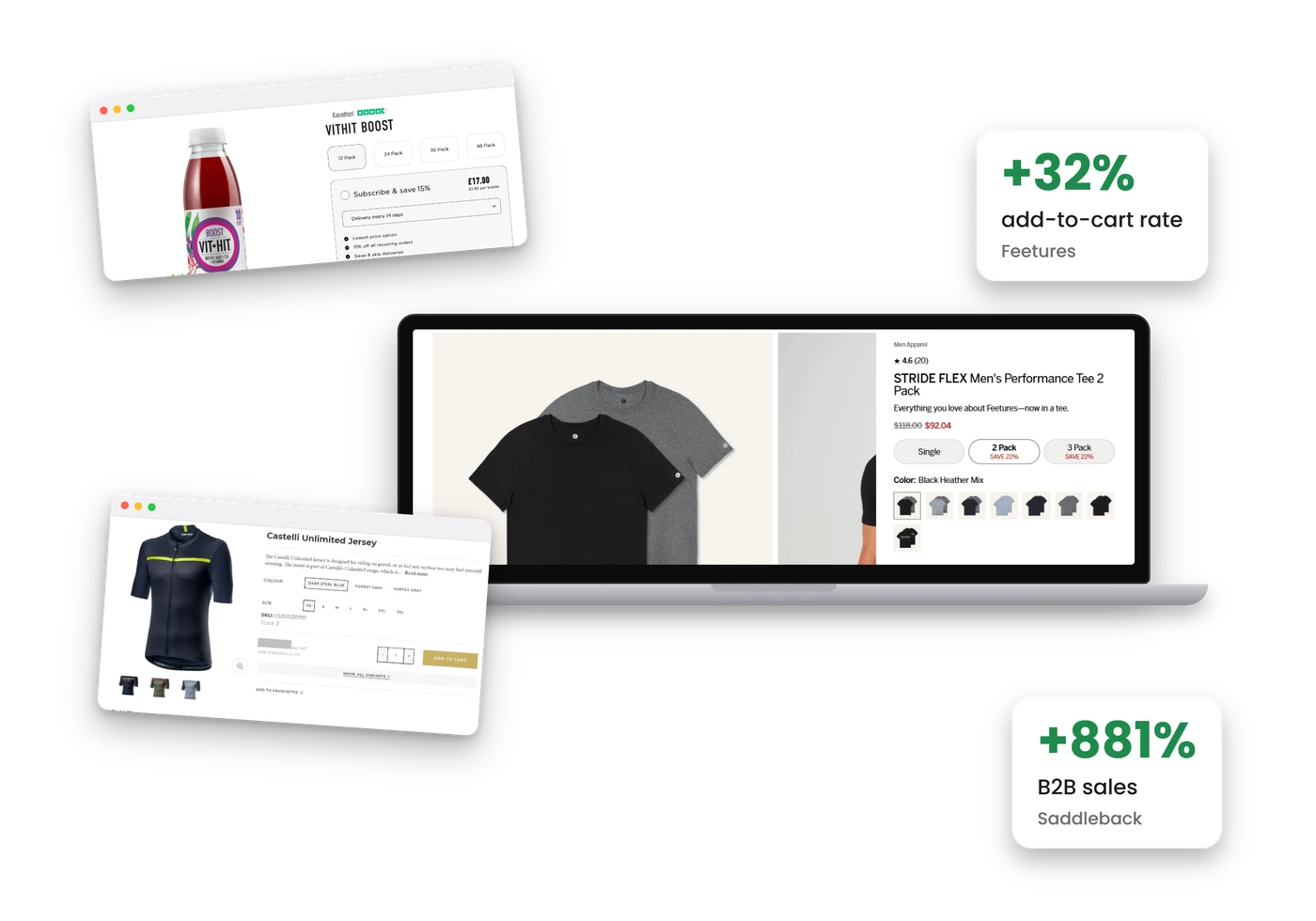
Feetures

Saddleback

VITHIT
What we do
Take one of these or all four. A Shopify agency Boston brands work with should let you start anywhere, and each row links to the store it was done for.
Design and build
B2B and wholesale
Migration

CRO
It never clicks. A search engine reads your product page as it arrives, and does nothing else. It does not open your size guide, expand your ingredients tab or scroll to load the rest. Anything that shows up only after a shopper acts is, as far as search goes, not on the page. The documentation for how pages get crawled says so outright.
And the summary built for machines is often empty. Every Shopify theme can publish a structured description of the product, separate from the words a shopper reads. It is what a search result or an assistant quotes. On 12 of the 26 stores we opened it held nothing usable: four published none, eight published under 120 characters.
Neither is a copywriting problem. Both live in your theme and your product fields.
Each takes a few minutes on your own store. Run them before you brief a Shopify agency Boston brands recommend. We ran them on 26 New England brand stores in September 2026, so you have something to measure against. Brands are counted, not named.
| The check | What we found across the stores | What it means for you |
|---|---|---|
| Does the answer need a click?Our own first pass missed those facts completely, which is exactly what a crawler does. That is the whole finding. | Sizing or ingredients appeared only after we opened a tab | A search engine reads the page as delivered and stops there |
| Does a machine get a product description?Your theme generates it, so an empty one is a setting rather than a missing sentence. | 12 of 26 gave nothing usable: 4 published none, 8 under 120 characters | That summary is what a search result or an assistant quotes |
| Does it say what size to buy? | 7 of 9 clothing and footwear stores, once we clicked. 2 said nothing anywhere | A shopper who can't find the size guesses, and guesses come back |
| Does it say how to wash it? | 3 of 9 clothing and footwear stores | Care is a question your support inbox answers instead |
| Does it name the allergens?The gap between those numbers is the point. Listing what is in it is not the same as naming what will hurt somebody. | 4 of 12 food and health stores, against 11 that listed ingredients | The one fact an allergic buyer needs is the one most often missing |
| Is it hiding in a picture?We expected this to be the headline and it was not. A check that comes back clean is worth as much as one that does not. | 1 of 26 stores | The thing everyone warns about is not what is going wrong |
The pattern is not that these brands hide facts in pictures. We went looking for that, and it barely happens: one store in 26.
What happens is quieter. The facts get written, then put where they open only for a shopper who clicks. A shopper in a hurry does not click, and a search engine cannot. Underneath, the structured summary is empty on half these stores.
Run the first two checks on your best seller. A Shopify agency Boston brands pick should be able to explain what you find.
The copy usually exists. Somebody wrote the ingredients and the fit notes. They just live in a tab that loads on click.
Where a fact is stored decides where it can appear. A size chart pasted into a theme section can only appear there. The same chart held as product data appears on the page, in the summary, in a feed and in a listing.
The summary is generated, not typed. Your theme and product fields build it, so an empty one is a setting nobody turned on.
Rather not run them yourself? Send us one product page and we'll run all six.
Get in touch with usThe same four promises whether you buy one fix or the whole build.
If the checks turn something up, you can have just that put right. If you don't need a redesign, we'll say so.
Sizes, ingredients and specs go into product fields. From there they show on the page, in your feeds and in your structured data.
The repository, the theme and the app accounts are in your name. If you leave, there is nothing to ask us for.
If it has to change, you see the change and agree to it first.
No, and we won't pretend otherwise. There is no office in the city to visit.
Most agencies on any shortlist are remote anyway, so ask each one where its team actually sits. What a Shopify agency Boston brands shortlist owes you instead is your hours, a named lead, and someone on call the day you release.
It is the most common thing we hear about the last Shopify agency Boston brands hired.
Scope is agreed in writing first. The work runs in phases you can stop at. Any change comes back to you before anyone carries on.
More of it than most people expect. Company accounts, price lists per location, order minimums, payment terms and reordering are part of the platform now, not an app you bolt on.
Which plan you need comes down to how many price lists you run. We'll tell you if yours already covers it.
A Shopify agency Boston brands vouch for should show you this. Each number links to its case study, so you can check it.
Ecomm Wizards identified the opportunity clearly and then proved it with real data. Two tests, two wins, and a growth roadmap we can actually act on. The quiz in particular has reshaped how we think about new customer acquisition.

The migration was seamless. Our customers noticed nothing, and neither did Google. The new store architecture reflects how our buyers actually shop, and the conversion numbers followed. Ecomm Wizards delivered exactly what they promised.

It starts with the six checks, run on your homepage and your best seller. You get a list of what a shopper can find, what a search engine can find, and where the two differ.
Then you choose. Fix what the checks found on the store you have, or fold it into a redesign, a migration or a B2B build. Either way the scope is agreed in writing first.
Whoever you hire, ask for that list before agreeing to a redesign. It is a fair first question to put to any Shopify agency Boston brands rely on.
The first step is the list of what your product pages are missing. It's free, and it's yours either way.
Get in touch with usSix to ten weeks for most stores once your scope is agreed. A migration carrying real order history runs longer, and the extra time goes on data rather than design.
Usually, yes. Most of what the checks find is product data and theme settings, and both can be put right on the store you have. A Shopify agency Boston brands keep should tell you when a rebuild is genuinely the cheaper route, and we will.
Often because it is not in the page a crawler receives. If your description loads only when a shopper opens a tab, there is nothing to read when it matters. Check the structured summary your theme publishes: on half the stores we tested, it was empty. It is the first thing a Shopify agency Boston brands bring in should look at.
Yes. Company accounts, price lists, order minimums, payment terms and quick reordering run on the same store as your direct sales. Your trade buyers sign in and see their prices. Your shoppers never see them. Setting it up is the job of a B2B Shopify agency Boston brands rely on.
A written scope, a list of what your store fails today, who is actually doing the work, and what happens after launch. Ask for the list first. Ours starts with the six checks and they cost nothing.
No. Our Shopify developers work remotely, not from an office in the city. We'd rather say so now than have you find out later. Your project runs the same either way: we scope it, build it, test it, release it.
Yes. We work with brands across Massachusetts and the rest of the region. Shopify developers New England brands brief remotely are normal now. Where your office sits does not change how the work runs.
Most brands keep us on for releases and fixes. If you would rather hand it to your own developer you can, and the documentation goes with it.
Next step
The same six checks from the table, run on your store.
Put your best seller in the form. We'll run the checks and hand you the findings:
It stops at the findings, and you can take the list to any developer.
No charge, and the findings are yours either way.
You'll hear back from a developer within a working day.
