







Ecomm Wizards
Ecommerce agency Atlanta

Ecommerce agency Atlanta brands hire to design the store and fix the catalog

Design, build, migration and growth, on whatever your store runs on today. We will also tell you when a new design is not what is losing you the sale.

150+
Stores built
$400M+
Revenue generated
8+
Years building stores
4.9★
Average client rating
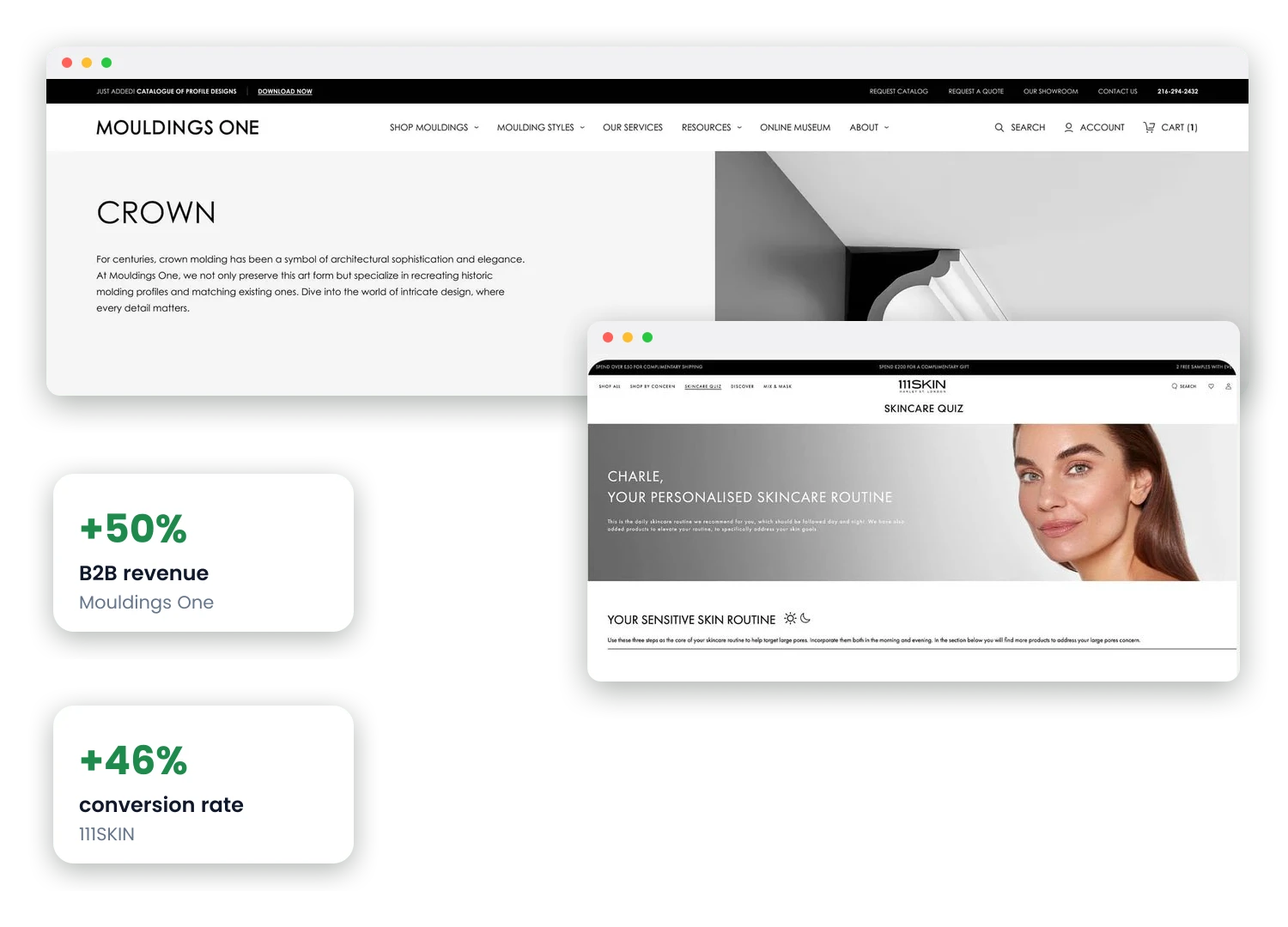
A category page we built for Mouldings One, carrying its own written description and two routes through the catalog in the menu, and a skincare finder we built for 111SKIN that turns the same product data into one person's routine, beside cards reading B2B revenue up 50% and conversion up 46%

150+ stores built, and the catalogs behind them.

Beauty, apparel, home. Trade ranges with forty sizes of one thing. Whichever ecommerce agency Atlanta brands you pick, make sure it reads your product data first.

When you look at your store you see pages somebody designed. A homepage, a product page.

Your customer mostly uses the parts nobody designed. The menu. The filters down the side. What comes back from the search box. Those are built automatically out of the small labels attached to each product.

So we read 26 stores and counted those labels: 9,926 products carrying 10,889 of them. On the middle store, three in ten were attached to a single product, which means they group nothing at all. That is the part an ecommerce agency Atlanta brands hire should open first.

In short

Ecomm Wizards is an ecommerce agency Atlanta brands hire to design, build, move and grow online stores. We work on the platform you are on today. We start with what is losing the sale, and it is more often the product data than the design.

Your product record is serving four masters

Atlanta brands rarely sell one way. There is the store, the wholesale side, the retail accounts, the marketplaces. The same product has to appear in all of them, which is the first thing an ecommerce agency Atlanta founders brief runs into.

So the product record fills up with instructions for other systems. Hide this from search. Do not send this to that app. Internal orders only. Wholesale, not retail. Every one of those is a sensible note to somebody.

None of them is a fact about the product. And the store builds your menus and filters out of exactly that field, which is why ecommerce development Atlanta brands pay for has to start under the surface.

Three stores, and what changed

111SKIN ecommerce store, a redesign built around how people compare products before buying

111SKIN

  • Shopify CRO
  • Theme Development
Vertical
Skincare
What was built
A redesign built around how people compare products before buying
Outcome
Conversion +46%, revenue +21%, AOV +4%
Mouldings One ecommerce store, a trade catalog and self-service ordering portal over a large product range

Mouldings One

  • Shopify Plus B2B
  • Custom Development
  • ERP Integration
Vertical
Trade and millwork
What was built
A trade catalog and self-service ordering portal over a large product range
Outcome
B2B revenue +50%, order processing down 74%, 340+ trade accounts
Twillory ecommerce store, a testing program run against the pages that decide the sale

Twillory

  • Shopify CRO
  • A/B Testing
  • Theme Development
Vertical
Menswear
What was built
A testing program run against the pages that decide the sale
Outcome
$5.4M new annual revenue, 70% of tests won

Nobody builds your category pages. They build themselves

This is the bit most owners have never been told. A collection on your store is usually not a list somebody wrote. The platform's own documentation describes it plainly: you set conditions, and matching products are included automatically. You can stack up to sixty of them.

Which means the conditions are the design. Whoever chose what a product is called, what type it is and what tags it carries decided what your customer can browse, filter and search. That was probably not a designer, and it may not have been a person at all.

And the same data runs more than the menu. Search results, related products, the filters on a category page. Redesign the page and all of it carries over unchanged, which is why an ecommerce agency Atlanta brands trust will ask for the catalog before the brief.

What 10,889 labels showed about finding anything

Search ecommerce agency Atlanta and you get directories, a few home pages, and nobody publishing a measurement. So here is ours. We read 26 stores from their own public feeds and counted the labels their menus, filters and search are built from.

What 10,889 labels showed about finding anything
What we countedAcross the 26 stores
Products read9,926
Distinct labels on them10,889
Labels attached to one product only, middle storeThey cannot group anything. The worst store was at 88%.30%
Stores where over half are like that5 of 26
Labels written for software, middle storeOne store's labels were all like this.42%
Products per category, middle store17
The coarsest store486 products in four: Men's, Women's, Unisex, Kids'.122 per category
The finest store69 categories for 77 products groups nothing either.1 per category

The two ways to get this wrong are opposites, which is what makes it worth measuring rather than asserting.

One store sells 486 things and files them under four labels: Men's, Women's, Unisex, Kids'. A jacket and a pair of socks are the same category. No menu can separate them, because the store does not know they are different.

Another has 69 categories for 77 products. Almost a category each, which groups nothing either. Both stores look fine. Both are impossible to shop past the first click. Either takes a morning to spot, which is why we would rather an ecommerce agency Atlanta brands meet looked before it quoted.

And the labels themselves are rarely about the product. The ones we read included instructions to hide an item from search, to keep it out of an app, to show it to staff only. Sensible notes, all of them, sitting in the field your filters are built from.

Three things to try on your own store tonight

  • Use your own search box the way a customer would. Type the plain word for a thing you sell, not its product name, and see what comes back.
  • Open a category page and look at the filters. If there are none, or they are the same four on every page, the data behind them is thin.
  • Open any product in your admin and read its tags out loud. If most of them would mean nothing to a customer, that is the field your store is sorting by.

Why a redesign leaves this exactly where it was

A redesign changes the surface. New type, new spacing, new photography, new homepage. Most ecommerce website design Atlanta brands buy is exactly that, and all of it is worth doing when the surface is the problem.

It does not touch the sorting. The menu still groups what it grouped before, the filters still filter on the same field, and the search box still looks in the same place. The pages are new and the routes through them are not.

Which is why the order matters. Fix what your store knows about your products first, and the redesign has something to work with. Any full-service ecommerce agencies Atlanta brands shortlist should be willing to say that before quoting the design.

Want the same count run on your own catalog? Tell us the store and we will send what we find.

Get in touch with us

What we do

Take one of these, or the lot

Every row links to the store it was done for, and none of it assumes you are starting again. Most brands arrive asking for the first one. Between them they are what an ecommerce agency Atlanta companies hire gets asked for.

Design and build

We design the store around what you actually sell

Most homepage design for ecommerce Atlanta brands commission is drawn before anyone has looked at the catalog it has to carry.

  • Storefront design
  • Homepage
  • Product data
  • Navigation and filters
  • Design systems
Explore store builds
A conversion-led redesign for the skincare brand 111SKIN111SKIN+46%Conversion Rate

Ecommerce development

We write the logic a theme has no opinion about

Catalog structure, integrations and the feeds that carry your products out to other channels.

  • Ecommerce development
  • Catalog structure
  • Integrations
  • Performance
  • Support
Explore ecommerce development
A trade catalog and ordering portal built for Mouldings OneMouldings One+50%B2B Revenue

Not sure which of the four you need? Tell us about the store and we will name the one we would start on.

Get in touch with us

Four things that do not move

They hold whether you buy one job or all four. Put the same list to every ecommerce agency Atlanta brands talk to before you choose.

  1. We look before we quote

    We read your catalog first and tell you what we find. If the design really is the problem, we will say so and get on with it.

  2. You see the number both ways

    We measure what we are asked to fix before we touch it, and again afterwards. You get both figures, not a description of them.

  3. Nothing is tied to us

    The code, the accounts and the data are in your name. If you leave, there is nothing to ask us for.

  4. Scope is signed before work begins

    If it has to change, you see it and agree before anyone acts on it.

Where people push back

“We came here for a redesign.”

Then you may well get one, and we build them. This is about the order of work, not a refusal.

We will read the catalog first because it takes an afternoon and it changes what the design has to do. If it comes back clean, we design and nobody has lost anything. It is the one check an ecommerce agency Atlanta brands hire can run before taking your money.

“Our tags are fine, we use them internally.”

They probably are fine for that, and we would not touch the ones your team relies on.

The catch is that the same field feeds your menus and filters. Internal notes and customer categories can sit side by side, but only if somebody keeps them apart on purpose.

“Our store is not on Shopify.”

That is fine, and it is not the first question we would ask. Every platform builds its menus and filters out of product data, and every one of them is only as good as what it has to sort.

If moving would help we will tell you, and if not we will tell you that too.

“Our catalog is small, so this will not apply.”

Often true, and we will say so rather than making work. Under a hundred products you can usually fix this by hand in a week.

It bites at a few hundred and upwards, and it bites hardest when you add a range, because new products inherit whatever the last ones had. Any ecommerce agency Atlanta brands recommend will tell you where that line falls.

What we would do in the first two weeks

We run the same count on your catalog and put it beside what your search box gets asked for. Those two lists settle the argument in an afternoon.

If people search for things you sell and get nothing back, the labels are the job and the design can wait. If they find everything and still leave, the design is the job and we will say so.

Either way you get the answer before you commit, which is the part an ecommerce agency Atlanta brands keep tends to get right.

The first conversation is about what is actually losing the sale. It costs you nothing, including when the answer is that we would change very little.

Get in touch with us

What brands ask before they pick anyone

  • Usually because the store cannot tell your products apart. Menus, filters and search are built from the type and tags on each item, so when those are thin there is nothing to sort by.

  • Most often neither to begin with. Read the catalog first: if people are searching for things you sell and getting nothing, that is cheaper to fix and it changes what any redesign should look like.

  • Two different jobs, which is the problem. They group products for customers, and they also carry instructions for other software. The same field does both on your store, and nobody is told to keep them apart.

  • Start under it, not on it. Work out the categories your customers would look for, give every product one, then build the menu from those. That is where an ecommerce agency Atlanta brands brief starts too.

  • Four things, broadly. Designs and builds your store. Writes the parts a theme leaves out. Moves it to another platform when it stops fitting. And finds what stops people buying.

  • Yes. We work on whatever your store runs on now. The first job is finding out whether the platform is the problem or something sitting on top of it, and usually it is not the platform.

  • Yes, and remotely is how it runs. There is no office in the city to visit. Where you sit does not change how the work is scoped, built or handed over.

  • Reading your catalog is an afternoon. Sorting a few hundred products takes a week or two, and most of that is deciding the categories, not typing them in.

  • Usually, and often it is the quickest route. We can hand them a plan and check the result, or take the parts nobody on your team has time for.

  • Then we design it, and we will have told you so in the first week. We would rather be the people who checked than the people who sold you a redesign that changed nothing.

Next step

Send us your store and we will count the labels

The same count from the table, run on your store.

Put your store address in the form, and you get back:

  1. How many of your labels are attached to a single product.
  2. How many products sit in your biggest category, and whether that category means anything.
  3. Which of the two is worth fixing first, and whether a redesign would have touched it.

You get the findings and nothing else attached to them.

Free, and nobody chases you afterwards.

A developer replies within one working day. Not a salesperson.

We've scaled 150+ stores. Let's see what's holding yours back.

Book a Free Call