The short answer
Headless commerce separates the storefront customers see from the commerce engine running products, carts and checkout, connected by APIs. Examples include Allbirds, Patta and Nour Hammour on Shopify Hydrogen; Victoria Beckham Beauty and Bamford on Shopify Plus with Contentful; Kotn and FIGS on Next.js; and Chilly's on Commerce Layer. Most brands under roughly $20 million revenue don't need it.
Two brands asked us about headless in the same month. We built one a Hydrogen storefront. The other we told to stay on their theme and spend the money on product pages.
Both were the right call. The difference between them is what this post is about.
Most headless commerce examples online are vendor customer lists, or projects from 2019 that nobody dated. That's a problem when you're building a case for your board.
Store owners describe the push the same way:
- "Our theme is holding us back."
- "Our site feels slow and I can't work out why."
- "Every small change needs a developer and a two-week wait."
Below: real stores with their stacks, three builds we worked on with measured results, what it costs, and when headless burns money.
Headless commerce examples and what headless means
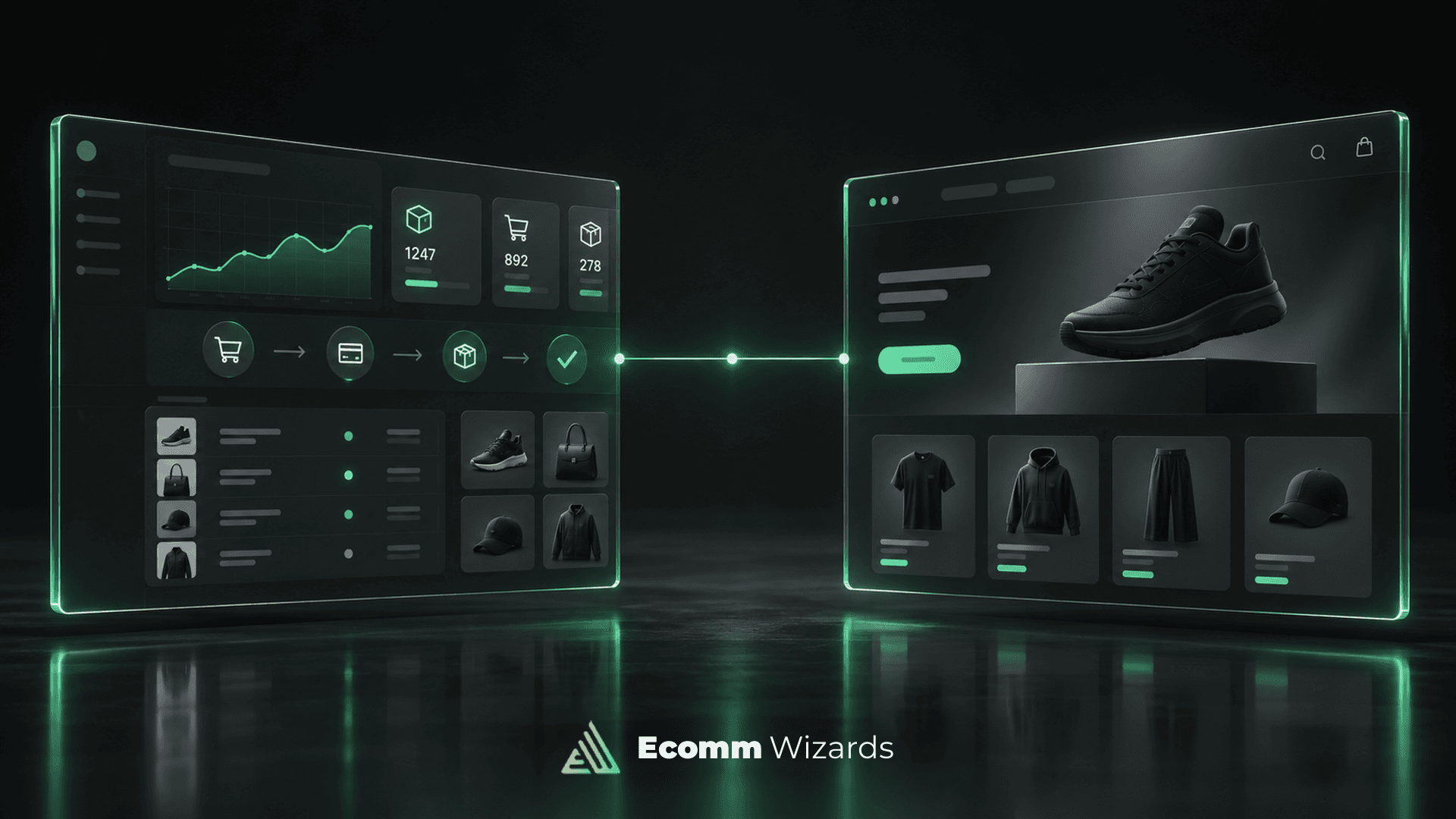
Headless commerce means the storefront customers see is built separately from the commerce engine that runs products, carts and checkout. APIs connect the two.
Real examples include Allbirds, Nour Hammour and Patta on Shopify's Hydrogen framework; Chilly's running Commerce Layer behind a custom front end; Victoria Beckham Beauty and Bamford on Shopify Plus with Contentful; and Kotn and FIGS on Next.js.
Brands go headless for multi-region selling, interfaces a template can't build, and content-led storytelling. It costs more and takes longer than a theme build. Most brands under roughly $20 million in revenue don't need it.
Composable commerce vs headless ecommerce, in plain words
These two get used interchangeably. They aren't the same thing, and the difference decides who maintains your store in year two.
Headless separates the front end from the back end. One commerce engine runs the business, and a custom storefront sits in front of it.
Composable goes further. Every capability becomes a separate service you pick and swap: search from one vendor, cart from another, content from a third.
The short version: all composable builds are headless, but not all headless builds are composable.
Our own work shows the split clearly. A Hydrogen storefront on Shopify Plus is headless, because Shopify still runs everything behind it. Chilly's, running Commerce Layer for commerce with a custom front end and six integrations, is composable.
Headless | Composable | |
|---|---|---|
Commerce engine | One platform | Services assembled from several vendors |
Vendors to manage | Usually two or three | Often six or more |
What breaks when one fails | A feature | Sometimes the purchase path |
Who it suits | Brands wanting front-end freedom | Operations too complex for one platform |
Where the regret lives | Year-two maintenance | Every swappable part needs an owner |
Composable is where most of the regret sits. Every part you can swap is a part somebody has to own.
Headless commerce examples, grouped by what the brand needed
Lists of headless brands in random order teach you nothing. Grouped by the reason they went headless, you can find yourself on the page.
Each one gives the brand, the commerce engine, the front end, and why. Where a stack can't be confirmed as current, it's marked as built rather than running.
Brands that needed to sell in many countries
Multi-region is the strongest single predictor of a headless build that pays for itself. Different catalogs, currencies and languages stretch a theme past its design.
- Allbirds — Shopify Plus with Hydrogen, decoupled incrementally rather than all at once. Documented across roughly 35 country storefronts, 50 retail stores, and a mobile app ordering through the Storefront API.
- Sennheiser — 25 separate headless storefronts running off shared commerce infrastructure.
- Rothy's — separate regional front ends sitting on one back end, so each market gets its own experience without a second platform.
- Chilly's — Commerce Layer with a custom front end. Our build, covered properly below.
Brands that needed something a theme cannot build
The clearest case for headless. A configurator, a drop mechanic, a booking flow, or art direction a template cannot express.
- Denim Tears — headless Shopify with Hydrogen, Oxygen and Sanity CMS. Culture-led fashion where editorial and product sit in the same breath. Our build.
- Patta x Tommy — a Hydrogen storefront built for a single launch, shipped in two weeks. Drop-driven retail with a hard date.
- Nour Hammour — Hydrogen deployed on Oxygen with Sanity CMS, built as a single-launch project.
Drops are the underrated one. When a release sells out in ninety seconds, the front end has a job regular retail never asks of it.
Brands where content is the storefront
Editorial that sells, owned by marketers rather than developers. The CMS and the commerce engine had to feel like one site.
- Victoria Beckham Beauty — Shopify Plus with Contentful, hosted on Netlify.
- Bamford — Shopify Plus with Contentful, after migrating off WooCommerce.
- ILIA — Shopify Plus with Contentful.
- Recess — a Vue front end with Sanity CMS.
- Daring — headless Shopify Plus on Hydrogen and React, recipe-led and mobile-first. Our build.
Brands that needed a channel beyond the website
Once you're feeding an app, a kiosk or an in-store screen from the same catalog, a theme stops being the right shape.
- Allbirds — the mobile app takes orders through the same Storefront API as the website.
- Kotn — Next.js on the Storefront API with a headless CMS.
- FIGS — Next.js on Shopify Plus, with separate landing page infrastructure.
- Paul Valentine — Nuxt and Vue.js on the Storefront API with Contentful.
Most of these builds were commissioned between 2019 and 2022, as documented by Charle in a list last updated July 2026. Treat them as examples of why brands went headless, not as a current architecture survey.
Headless Shopify examples specifically
Headless Shopify examples deserve their own section, because that's where most people asking this question already are.
Brands documented on Hydrogen include Allbirds, Nour Hammour and Patta. Others run custom React or Vue front ends on the Storefront API instead: Kotn and FIGS on Next.js, Paul Valentine on Nuxt, Recess on Vue.
What they share matters more than the framework. Every one of them is committed to Shopify long term. Each has engineering capacity, in-house or retained, plus a front-end need a theme couldn't reach.
Here's the part most agency pages skip. Headless does not hand you technical SEO. A theme gives you sitemaps, canonical tags and robots rules for free. Build your own front end and those become your job.
Shopify's own position is worth quoting against the trend. The platform points typical stores at a modern Liquid theme and reserves headless for advanced, high-customization builds. When the vendor selling the framework says most people don't need it, listen.
If you're weighing it up, our headless Shopify agency page covers how we scope these.
Three headless builds we worked on, and what we learned
The headless commerce examples above come from secondary sourcing. These three we built, and the numbers are our own measurements.
Chilly's — Commerce Layer with a custom front end. The British reusable bottle brand sells in frequently changing colours, prints and limited editions. Their theme made every layout change a workaround, and the workarounds cost money each time.
We moved them onto Commerce Layer with a front end built around their design language, plus six integrations. The rebuild took 10 weeks flat.
Load time dropped 42%, to 1.8 seconds. Conversion rate rose 28%, average order value 19%. Running costs fell 31%, helped by removing eight apps they no longer needed. Lighthouse came in at 96 on desktop, 94 on mobile.
The teaching point: this is composable, not merely headless. The cost saving came from consolidation rather than from headless itself.
Daring — headless Shopify Plus on Hydrogen. Plant-based chicken, with recipes and brand story selling as hard as the product pages. The shop and the story could not feel like two websites.
We built a Hydrogen and React storefront on Shopify Plus. Conversion rate rose 38%, average order value 27%, mobile conversions 31%. Page load improved 42%, homepage at 1.8 seconds, mobile performance 92 out of 100.
The teaching point: content-led brands get the most out of headless when the content model is part of the plan from day one. Bolt a CMS on afterwards and you've bought complexity without the benefit.
Denim Tears — Hydrogen and Oxygen with Sanity CMS. Culture-led fashion where the history behind a piece matters as much as the piece. Editorial could not slow the site, and shopping could not crowd out the story.
Conversion rate rose 38%, page load improved 45%, mobile conversions 29%, average order value 24%.
This was built during an earlier phase of the brand's growth, so treat it as a record of that project rather than a description of their current site. The teaching point: heavy art direction and drop mechanics are a real theme ceiling, not an imagined one.
What all three had that most brands do not
- Engineering capacity, in-house or on retainer
- A written reason a theme couldn't do the job, agreed before anyone wrote code
- A content model with a named owner
- Budget for year two, not just the build
Miss any one of those and the build usually disappoints. All three are in our case studies with full figures.
Headless commerce advantages and benefits
Most pages write this as abstract bullets. Tied to the headless commerce examples above, the advantages become evidence instead.
Advantage | What it means in practice | Where it showed up |
|---|---|---|
Front-end freedom | Build interactions a template cannot express | Denim Tears' art direction, Patta's drop launch |
Multi-region at one scale | One engine, many markets and currencies | Allbirds across ~35 storefronts, Sennheiser across 25 |
Channels past the website | Apps and screens off the same catalog | Allbirds' mobile app on the Storefront API |
Content and commerce together | Editorial that sells, owned by marketers | Victoria Beckham Beauty, Bamford, Daring |
Independent teams | Front end and back end ship without blocking | Any build with a CMS in scope |
Swap a part without a rebuild | Composable only, and the hardest to earn | Chilly's on Commerce Layer |
The advantage that is usually oversold
Speed. Let's be direct about this one.
Going headless does not make a site fast. Good engineering does, and you can do that on a Liquid theme for less. Modern themes post strong Core Web Vitals, and a badly built headless storefront loses to a well built theme every time.
If speed is the only item on your list, the honest answer is a theme and a speed optimization project.
When headless is the wrong call
This is the section nobody selling headless wants to write.
Brands do move back
Agencies that built headless storefronts now run steady business moving brands off them. Soft Limit, writing about mid-market DTC, puts it plainly: recent headless projects "more often than not" run the other way, and for brands in the $5M to $100M range the answer is "almost always no."
Framing matters here. Headless was right for many of those brands when they chose it. Needs changed, teams changed, and the platform caught up underneath them.
What you won't find is a lot of named reversals on the record. Brands rarely publicise a replatform that didn't work, which is exactly why the success stories are so much easier to find than the regrets.
The five situations where it burns money
- Your marketing team ships content weekly. Without a CMS in the build, every change becomes a developer ticket. This is the most common regret at the twelve-month mark, by a distance.
- Speed is the whole reason. Covered above. Fix it on the theme.
- You have no engineering capacity. The build is the cheap part. Year two is where the real cost lives.
- You have a launch date. Headless builds commonly run 14 to 24 weeks against 8 to 14 for a theme. Aim at a season and that gap is real revenue.
- The theme just feels constraining. That's usually a design and information architecture problem. Far cheaper to fix inside the theme than to rebuild the front end.
What changed on the platform side
Online Store 2.0, checkout extensibility and metaobjects have absorbed a lot of what used to require going headless. The bar is higher than it was two years ago.
The honest consequence: fewer brands need headless now than did then. If you're already headless and regretting it, theme development is a real route back, and Liquid to Hydrogen covers the other direction.
The best headless commerce platform depends on what you're already on
A ranked list would be the one dishonest section in a careful post. "Best" is entirely situational, so here's a fit table instead.
Stack | What it is | Best fit | Watch out |
|---|---|---|---|
Shopify + Hydrogen | Shopify's own toolkit for the Storefront API | Brands staying on Shopify wanting the supported path | Changes with date-based releases |
Shopify + Next.js | Custom React front end on the Storefront API | Teams with existing Next.js skill | You wire up cart, caching and accounts yourself |
Commerce Layer | API-first commerce engine, genuinely composable | Multi-market, multi-currency operations | More vendors, so more to own |
Centra | Commerce engine popular with European fashion | Brand-led fashion across many markets | Smaller ecosystem than Shopify |
commercetools | Enterprise composable platform | Large enterprises with engineering teams | Cost and complexity are the common complaints |
Adobe Commerce headless | Enterprise, often with a headless CMS on top | Existing Adobe estates | The licence is the smallest part of the bill |
BigCommerce headless | API-first, lighter enterprise option | Mid-market wanting less enterprise weight | Smaller app ecosystem |
What Shopify's own stack looks like now
This changed recently, and plenty of guides haven't caught up.
Hydrogen used to be a framework built on React Router. As of the 2026-10 release, which went generally available on 14 October 2026, it's a library that works with any JavaScript framework. Starters ship for React Router and Next.js. Oxygen remains the hosting and remains free, though you can host a Hydrogen build elsewhere.
Two details carry practical weight. Hydrogen now uses the same standard storefront actions as Liquid themes, so apps and shopping agents share one cart contract. Storefronts can also work with shopping agents in browsers supporting WebMCP.
What this means for you: a Hydrogen project started today looks different from one shipped a year ago. An agency's older Hydrogen work doesn't prove they can ship on the current version.
Worth knowing about Oxygen before committing. You get one Hydrogen build per store, so a separate wholesale portal pushes you toward a multi-store setup. Logs are kept 72 hours at most.
The CMS question
Brands forget this one until it hurts. If marketers need to publish without a developer, a headless CMS isn't optional.
Contentful and Sanity show up repeatedly in the examples above. Both are a real monthly line item on top of everything else, plus the integration work to connect them.
What a headless build actually costs
Theme build | Headless build | |
|---|---|---|
Typical timeline | 8 to 14 weeks | 14 to 24 weeks |
Build budget | Baseline | Roughly 20% more on comparable scope, often far more |
Ongoing engineering | Light | Continuous, and the real cost |
CMS | Built in | Separate subscription plus integration |
Hosting | Included | Oxygen, or your own infrastructure |
Who ships a landing page | A marketer | A developer, unless a CMS is in scope |
The cost people miss
Year two. The build is a project with an end date, and the maintenance is a standing commitment.
Framework upgrades, dated API releases, dependency updates, and an engineer who understands the whole thing. A brand without a plan for that shouldn't start, and maintenance and support is the budget line most people forget to open.
How to tell which group you're in
Screenshot this bit.
Go headless when at least two of these are true, and write your reason down before you start:
- You sell across many markets with different catalogs, languages or pricing
- You need an interface a template can't express, like a configurator or booking flow
- You're feeding more than a website: an app, a kiosk, an in-store screen
- Your pricing or inventory logic lives in a system outside the commerce platform
- You have engineering capacity you're confident about for the next two years
Stay on a theme when:
- One storefront, one region
- Marketing ships content weekly and owns the calendar
- Your complaint is speed, or that the site looks generic
- You have a launch date inside four months
- Nobody can name who maintains the front end next year
One thing to plan for that didn't exist before
AI assistants now find and compare products for shoppers. Shopify stores expose an agent endpoint so those systems can read live product, cart and customer data.
A custom front end means you own the structured data, the crawlability and the agent surface that a theme would have handled for you.
Same gap that hurts you in Google search. Product schema, feeds and agent readiness belong in the build scope, not a fix afterwards. Our agentic commerce and Shopify SEO work exists because this gets skipped.
The newer Hydrogen releases help here, sharing a cart contract with Liquid themes so agents can transact the same way on both. Worth asking about if you're scoping a build now.
Thinking about a headless build?
We build headless storefronts, and we talk brands out of them more often than we build them.
A scoping engagement produces five things: the written reason, the architecture, the CMS decision, the two-year cost, and an honest recommendation. Plenty of those are a theme.
For context: Shopify Plus Partner, 150+ stores built, 8+ years, 9+ industry awards, with headless builds shipped on Hydrogen, Oxygen and Commerce Layer.
Both doors are open. Headless Shopify agency for the build, Liquid to Hydrogen for brands moving either direction. Book a call and we'll tell you which one you need.
None of the headless commerce examples in this post went headless to be headless. Each had something a theme couldn't do, and the engineering to back it up. Write your reason down first. If you can't fill the page, the money is better spent somewhere else.
Last updated